




B2B Marketing Strategy

We help you communicate the right messages at the right point in the customer journey. Make life easier for sales with collateral that effectively supports their efforts to build relationships.
Wherever your prospects are on the buyer journey, we write the words that move them to the next step.
Gunning Marketing's collateral service creates the brochures, direct mail, newsletters, case studies, and adverts that support a sales process at every stage of the buyer journey. Copy is built around what a specific audience cares about and what triggers them to act, so every piece is a genuine tool for building rapport, addressing objections, and moving a prospect forward.
The service suits B2B marketing and sales teams that need effective collateral to support lead nurturing, event activity, or account-based campaigns, drawing on over 2 decades of experience writing for every stage of the customer journey.
It's all about asking the right questions.
Who's your ideal client? What drives them? Most importantly, what are the triggers that compel them to act? Armed with these answers, and two decades of copywriting expertise, we articulate the right message for every stage.

Equip sales with the arguments, proof points, and follow-up materials they need to establish rapport and build trust.
B2B prospects are rarely the sole decision-makers. We help make your case.. and their internal business case, too.
Winning the sale is only half the battle. Keep your customers engaged, empowered, and loyal to your brand.
Give prospects something to refer back to as they navigate the decision-making process, and stay part of the conversation even when you're not in the room.






The feedback I have just had from one of my superiors is: 'Everyone loves this ad and the new messaging/copy.' So well done and thank you! I think in such a short time working on this, we are already making a huge impact. I can't wait to progress further with it all.


They have the rare ability to convert Nordcloud’s portfolio – both technical and transformational – into stories that are interesting, easy to consume and meaningful to customers.


The brief was to raise the profile of homeshare across a wide range of media, and Gunning Marketing took on the challenge in a thoroughly professional, creative and effective way. The press release they prepared, and the infographic produced to support the key messages, have had a measurable impact on the awareness of homeshare as a concept - relieving loneliness and social isolation for older people and those living with disabilities - as well as of the umbrella organisation, Homeshare International, itself. We are happy to recommend Gunning Marketing without reservation.

Book a free, no-obligation chat to discuss your requirements.
Sales collateral that isn't being used almost always has one of 3 problems:
A good test for any piece of collateral is whether a salesperson would reach for it in a real conversation. If the honest answer is no, it needs an update.
Involving the sales team in the briefing process is the most reliable way to close this gap. They can provide input into which
Collateral built around those specifics gets used, compared with collateral built around the marketing team's sense of what's important.
Flexibility is also undervalued. A single brochure that tries to serve every prospect situation will be used sparingly, because it's rarely the right fit for any specific conversation. Can collateral be structured modularly – where sections can be combined or adapted for different audiences, sectors, or deal stages? This allows sales teams to tailor their approach without requesting new materials every time. This is the model Gunning Marketing used for Crescent People's assessment services brochure: a pick-and-mix format that allowed the team to combine sections depending on whether they were speaking to a direct corporate client or a recruitment agency intermediary.
Finally, collateral needs to be as easy to find as it is to use. One common reason good collateral goes unused is that salespeople can't locate it quickly. A well-organised, accessible content library – even a simple shared folder with clear naming conventions – is as important as the collateral itself.
A B2B case study that wins business describes the client's situation in enough detail that a prospect in a similar position thinks 'that's exactly where we are'. This is different to confirming you’ve done similar work before. The situation, the challenge, and the complications that arose during the process are as important as the solution and the result. You can tell this story whether or not you can name the client, can include quantifiable outcomes, or have a testimonial.
A structure that works is:
If you can include the client's own words at any of these stages, it’s even better.
Specificity makes a case study more effective. 'We improved their content performance' does nothing. 'We built a content programme that generated a 104% increase in organic traffic, a 115% increase in referral traffic, and more than £50,000 in revenue from a single automated email campaign over 12 months' tells a prospective client exactly what kind of impact is possible and gives them the evidence they need to make the case internally.
If the client will let you name them, name them. Named case studies are more persuasive than anonymised ones because they give prospective clients a reference they can investigate independently. However, anonymised case studies still tell effective stories, and most prospects will understand the commercial sensitivities that surround naming clients (since they face them, too).
Collateral that works across the whole sales cycle is built on clear answers to these questions at each stage: what does the prospect need to know, believe, or feel at this moment to move to the next stage? The answer is different at first contact, needs discovery, proposal, and close. Collateral that tries to do all of those jobs in a single document almost never does any of them well.
At the awareness stage, collateral needs to establish that you understand the prospect's world and have relevant experience. A sector-specific overview, a relevant case study, or a thought leadership piece that addresses a specific challenge the prospect is facing is more effective than a capabilities brochure at this stage.
At the consideration stage, the prospect is evaluating options. Collateral needs to make the differentiation case clearly – what you offer that alternatives don't, why that matters for their specific situation, and the evidence that supports the claim. This is where detailed case studies, testimonials, and proof of methodology do effective work.
At the decision stage, the prospect is managing risk and building the internal business case. Collateral needs to give them the ammunition to make the case to others in their organisation – the financial rationale, the reassurance, the reference points that make the recommendation feel safe. A one-page summary of the relevant case study results, a clear statement of the engagement model, or a concise answer to the objections that typically arise at this stage can be the difference between a stalled deal and a closed one.
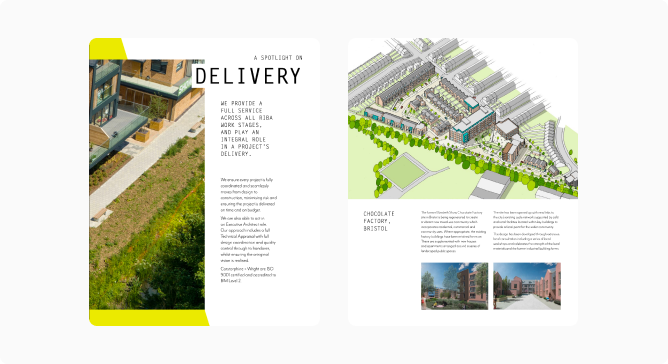
Gunning Marketing worked with Corstorphine & Wright – an award-winning architectural practice – on a suite of sector-specific brochures alongside brand proposition and web copy, giving their business development team materials that worked across different client types and conversation stages. Marketing Manager Sarah Breedon described the relationship as providing 'not only great copy, but valuable strategic input on how to position the practice in our markets and in line with our growth ambitions.' Read the Corstorphine & Wright case study here.
A B2B brochure gets read when it gives the recipient something useful – a perspective, proof point, an answer to a relevant question – rather than information about the company that serves your interest rather than theirs. The structural mistake most B2B brochures make is leading with the company – its history, its services, its credentials – before establishing why any of that matters to the reader. Reversing that order – starting with the reader's situation, establishing relevance, building credibility, making the case for engagement – produces a brochure that's considerably more likely to be read and prompt the next stage of conversation.
The right length for a B2B brochure is the length it takes to make the case – not the length that feels weighty enough to justify the print budget. A tightly written 4-page brochure that addresses one audience and one proposition clearly will outperform a 16-page comprehensive guide that tries to cover everything and ends up being convincing about nothing.
The brief that produces the right result answers 6 questions:
Then, get inputs from at least one front-line salesperson as well as from the person driving the strategy and proposition. That way, you combine knowledge of people interacting daily with the target audience with insight from the person with wider understanding of the sales and marketing direction.
Show examples, too. The fastest route to the right result is showing a copywriter what good looks and doesn’t look like – it could be a competitor's brochure with a discussion of what you like and don’t like, or even a piece from a different industry that captures the right tone.
Be explicit about the distribution context. A brochure that will be sitting on an event stand has a different job than one that will be emailed as a PDF follow-up to a meeting, which is different again from one that will be presented during a sales conversation. The context in which collateral will be used shapes decisions about format, content, length, and call to action.
Finally, agree the review process upfront. The most common cause of collateral projects running over time and budget is an approval process that wasn't defined at the start – new stakeholders introduced late, rounds of feedback that introduce contradictory requirements, or consensus-seeking that strips out the specificity that made the first draft work. Defining who has final sign-off, how many review rounds are included, and what constitutes a substantive change versus a stylistic preference at the briefing stage saves significant time and frustration later.
Consistency across a portfolio requires 3 things:
The most common cause of inconsistency isn't that different writers have different styles – it's that different pieces of collateral were built on different assumptions about what the brand is, who it's talking to, and what it's trying to achieve. A value proposition and messaging framework that's clear, specific, and accessible to everyone producing content is more effective than a review process that tries to fix inconsistency after the fact.
When a portfolio spans multiple sectors, audience segments, or use cases, the challenge is maintaining a consistent brand voice while adapting the emphasis and evidence to suit each specific context. The discipline is distinguishing between what should be consistent (the voice, the underlying value proposition, the standards of specificity and evidence) and what should flex (the sector-specific proof points, the vocabulary that resonates with each audience, the emphasis within the proposition).