




Copywriting Tips
Technical excellence means nothing if you don't connect with your ideal customers on a human level.
We translate your USPs into compelling, actionable, SEO-friendly narratives that slot right into your wider marketing strategy and bring more enquiries through the door.
Gunning Marketing web copywriting turns website visitors into enquiries, written around what a B2B audience needs to know before they get in touch. That covers homepage and service page copy, landing pages, and site-wide messaging built to work for humans, search engines and AI answer engines alike. Every page is developed from a business's specific USPs and value proposition and mapped to where a prospect actually sits in their decision-making – so each page does one clear job instead of repeating the same generic pitch.
The service suits organisations that need their marketing and sales strategy translated into copy that reads naturally, ranks well in search and AI engines, and nurtures prospects.
Strategy and execution should work hand in hand, not in parallel vacuums.
We home in on what's most likely to move the needle toward your specific goals and plan around it. And we never try to shoehorn your marketing into a one-size-fits-all methodology.

Don't miss the wood for the trees. We turn data and tech specs into stories your prospects can see themselves being the stars of.
Show prospects how you'll make their lives better, with meticulously-structured copy that resonates long after they log off.
We've helped our clients achieve 45% year-on-year time-on-page boosts and 47% increases in web conversions.
Spell out your USPs in language that positions you as the go-to solution to your prospects … and other decision-makers.





Gunning Marketing is exceptionally easy to work with. Their approach is efficient, intelligent and highly organised. They approach everything with pragmatism and creativity and a strong sense of the most valuable approach to the project on hand. A joy to work with on detailed and complex projects.


All the Gunning Marketing staff were wonderful to work with for our new website. I really appreciated their attention to detail, timeliness, and understanding of what is important to highlight about our business. I will definitely use them again and highly recommend Anna and her team.

Working with Anna and the team have made my life so much easier. They were able to interpret, understand and feel the Tola brand. They helped with the copy creation for our new site, basically starting from scratch. I fully recommend Anna and Gunning Marketing, and I will continue to work with her as an extension of my team.


Book a free, no-obligation chat to discuss your requirements.
The clearest signal is whether a visitor who knows nothing about your business can answer 3 questions in the first 30 seconds:
If the homepage makes the visitor guess on any of these points – or spend time navigating around to answer them – you likely need to focus your messaging to make the website work harder for you.
Other reliable indicators are:
A useful diagnostic is to remove your logo and name from the homepage and show it to someone unfamiliar with the business. Can they describe what you do, who you serve, and why you're different? If not, the copy is due a refresh.
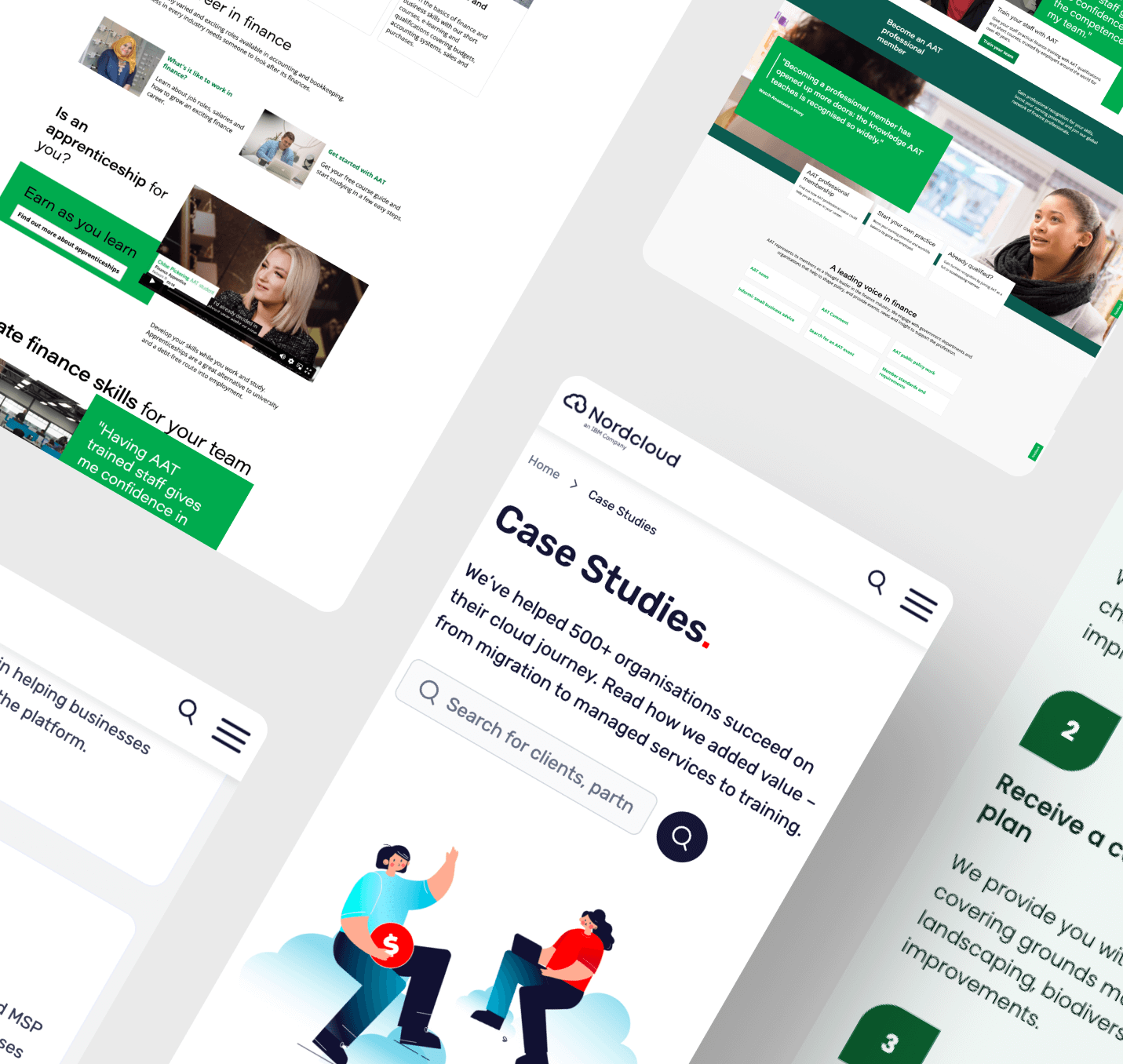
The web copy Gunning Marketing produced for Nordcloud – a European leader in cloud migration and managed services – supported a 45% increase in web conversions year-on-year and a 47% increase in time on page. Read the case study here.
Converting copy answers the question the visitor is actually asking, not the question the business wishes they were asking. In B2B, that question is almost always a version of: 'Are these the right people for my situation, and can I trust them to deliver?' Copy that leads with company credentials, service lists, or generic claims about quality fails this test immediately. Copy that demonstrates understanding of the visitor's specific situation, challenges, and goals passes it.
Structural disciplines that improve B2B web conversions are:
This last point is key. The homepage matters to hook people deeper into your content, but it's often the services pages and case study pages that determine whether a visitor makes contact. Case study page views for Nordcloud increased by 645% year-on-year following the website relaunch – which reflects both the quality of the content and the structural decision to make case studies easy to find and navigate.
A homepage that immediately communicates needs to answer 3 questions above the fold – before any scrolling:
A common pitfall is spending that homepage prime real estate on a tagline or image the company finds meaningful but the visitor finds opaque.
The 'why different' question is where most B2B homepages fall flat. Quality, expertise, and client focus are claimed by every competitor. Differentiation comes from specificity: the sectors you serve, the outcomes you deliver, the methodology that produces those outcomes, or your particular combination of capabilities that isn't available elsewhere. It can also come from voice – creating a brand personality that sets you apart. The test is whether a competitor could use your homepage copy unchanged. If they could, it's not differentiated.
Structure the homepage around readers and their journey, not the company's story:
The same principle that applies to writing for search engines applies to writing for AI models: optimising for the machine at the expense of the human reader doesn't work. AI answer engines – ChatGPT, Perplexity, Google AI Overviews – reward content that genuinely answers questions, demonstrates real expertise, and is structured clearly. That's the same content that converts human visitors. The discipline is writing for the reader first, then ensuring the structure supports LLM extraction.
The practical difference between copy that AI systems cite and copy they skip is structural clarity and specificity. AI systems extract answers to specific questions. Copy that opens each section with a direct answer to the question that section addresses – rather than building to a conclusion – is more extractable. Specific claims with named evidence (client names, percentages, concrete outcomes) are more citable than general assertions. And language that reflects how buyers actually ask questions – conversational, specific, problem-framed – aligns with the queries AI systems are answering.
What doesn't help GEO:
Tactics that support GEO without compromising copy quality are:
A brief that gets the right result first time answers 5 questions:
The audience question is the most often underspecified. 'Our audience is B2B decision-makers' tells a copywriter almost nothing. 'Our primary reader is a Head of IT at a mid-market financial services firm who has been asked by the CFO to evaluate cloud infrastructure options and is worried about the implementation risk' gives them detail to make the right choices about tone, vocabulary, depth, and what to lead with.
Examples are often more efficient than descriptions. If there's a competitor's page, a piece of copy the business admires, or a previous version of the copy with notes on what worked and what didn't, include it.
Also specify what you don't want. Brand no-nos, phrases that have already been rejected internally, content that's off-limits for compliance or competitive reasons – these constraints are as important as the positive brief.
The distinction people miss is that SEO and conversion aren't 2 different goals, they're 2 different lenses of the same goal. SEO focuses on getting the right people to the page. Conversion copy focuses on what happens when they arrive. Don’t treat them separately: a page that ranks but fails to establish relevance quickly sees high bounce rates; a page with excellent conversion copy that nobody finds doesn't move the pipeline.
Effective copy understands search intent – not the keyword itself, but the actual question behind it. A financial services firm searching "cloud migration for regulated industries" isn't looking for a definition of cloud migration, they're looking for evidence that someone understands their specific constraints and has solved for them before. Copy that addresses that specific intent ranks and converts.
GEO – visibility in AI search results – adds a third layer. AI systems increasingly mediate the discovery process before a visitor reaches the website at all, surfacing answers directly in response to conversational queries. The copy that earns AI citations is built on the same foundations as copy that earns human trust: specific, evidenced, genuinely useful, and structurally clear. A direct answer to the question the section addresses, named proof points an AI system can cite with confidence, and language that reflects how buyers actually ask questions support GEO without compromising copy quality.
Writing for all 3 audiences – human reader, search engine, and AI answer engine – should be one brief, executed with discipline. The businesses that struggle are those that optimise for one at the expense of the others: keyword-stuffed copy, beautifully written pages that nobody finds, or AI-optimised content that sounds like everyone else's.
Gunning Marketing's approach starts from search intent and buyer decision-making, then ensures the copy and structure support both search visibility and conversion – including the GEO tactics that are increasingly determining whether a business appears in AI-generated answers at all.