Events

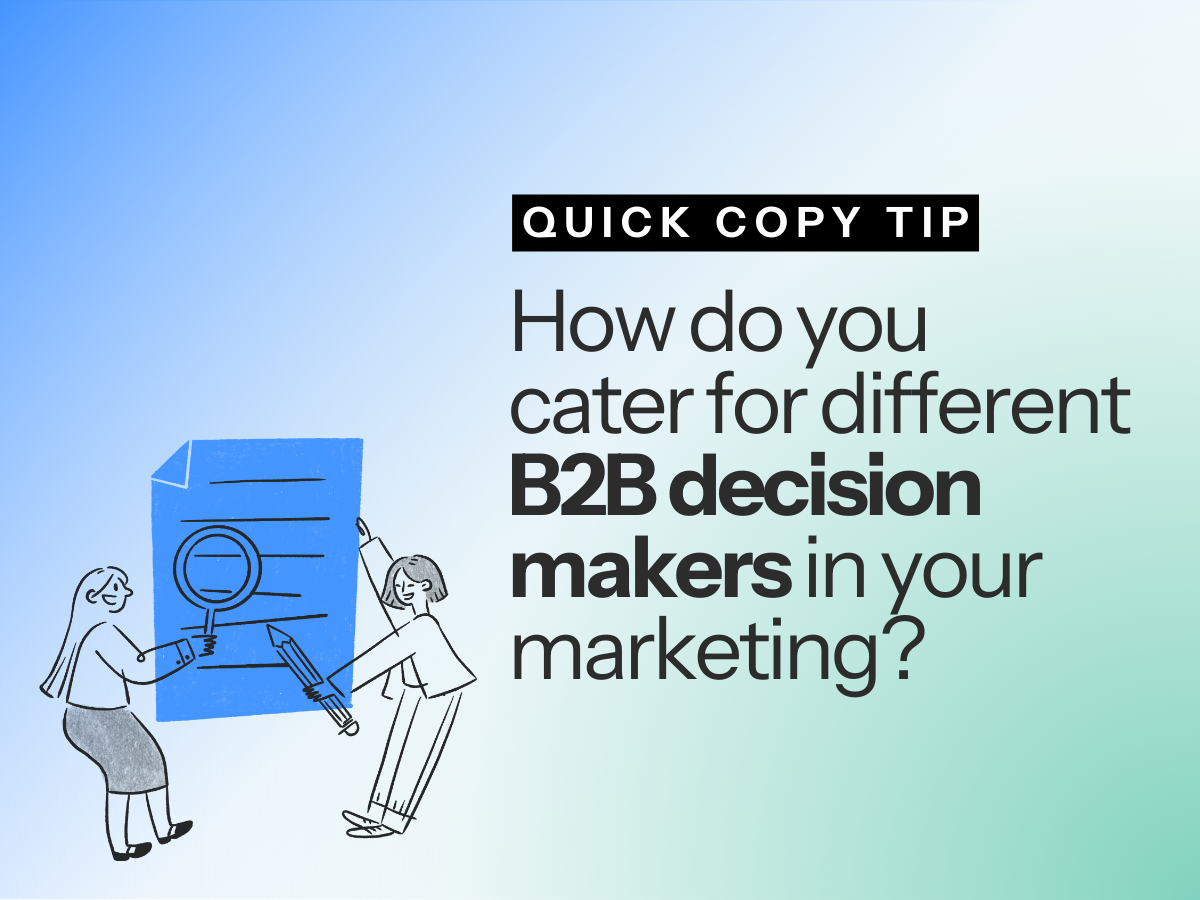
B2B purchasing is rarely a solo act. Depending on which analysts you follow – Gartner, Forrester, IDC – you’re typically looking at between 6 and 17 people involved in a purchasing decision. And those people don’t sit neatly in one department. IT, Finance, Operations, Engineering, Legal, Procurement…they can all have a seat at the table, and they all have different priorities, anxieties, and questions they need answered before they sign off.
So how do you write one website, brochure, or whitepaper that speaks to all of them?
You don’t. At least, not entirely.
Here, we look at how to cut through – so you don’t end up sounding too generic, but you also don’t end up with an unwieldy and expensive content engine.
There will always be crossover between decision makers – areas where their priorities converge. Cost savings, productivity gains, throughput, energy efficiency, compliance, and risk reduction are rarely confined to one function.
Therefore, your headline messages – the ones doing the heavy lifting on a homepage hero or a brochure cover that several audiences see – should sit at that point of convergence. This isn’t because you’re trying to appeal to everyone at once (vague, generic content won’t nurture anyone), but because you’re starting where the common ground is and making your case from there.
The mistake many companies make is leading with features and capabilities and then expecting the reader to do the translation work. Your job is to make the “so what?” explicit – and when the “so what” speaks to a shared pressure across the buying group, you’ve given yourself a fighting chance of landing with all of them.
Some channels are unforgiving. A website homepage has to be all things to all people, within reason. A brochure lives in a meeting room where multiple stakeholders might pick it up. You can’t write a separate version for each.
But other channels give you more control.
Email and digital advertising, for instance, allow you to target by role. You can serve a message about operational efficiency to an Operations Director and a message about risk management to Compliance – same product or service, different angle and emphasis.
Even on your website, you can make intelligent structural choices. Once you’ve captured someone on the homepage, you can then funnel them quickly into messages that speak to their priorities. Dedicated persona pages can do a lot of heavy lifting here, giving readers a clear path to content that speaks directly to their context. But so can smaller content blocks on the home, about, or product/service pages, as well as case studies that can be filtered by driver, industry, or function.
Brochures can do this, too. Consider interspersing testimonials from priority personas, benefit sections framed around specific functions, and case studies that make explicit which part of the buying organisation felt the impact.
Not all decision makers engage with your content in the same way – or at the same stage.
In many B2B purchases, an end user or influencer is doing the initial research. They’re the ones reading your blog posts, watching your videos, and comparing options. Then, they brief the budget holder, who may only engage at RFP or later evaluation stages. In some organisations, procurement only comes in later, primarily doing credibility and compliance checks rather than in-depth assessments.
Understanding where each stakeholder enters the buying journey changes what content you need to produce – and where. If your primary researcher is a Head of Data, your top-of-funnel content should speak their language, address their specific pressures, and give them something they can take to the next conversation. The CFO might never read a blog post, but they may look at your case studies for proof of savings generated, your client list, and your pricing structure.
So think about what each stakeholder needs to know at the point they engage, and structure your content accordingly.
B2B companies are often so close to their own product or service that their messaging defaults to describing what they do, rather than what the buyer gets from it. And when you’re writing for a diverse buying group, that problem compounds. Finance doesn’t want a feature list – they want to know what the payback period is. Operations wants to know what the implementation process looks like and whether it will disrupt production. The CTO wants to know whether it integrates with existing systems and who owns the data.
Yes, it’s more work than writing one piece of generic content, but taking this strategic approach is where you move from content that gets ignored to content that drives ROI.
Anna Gunning is the director of Gunning Marketing, a specialist B2B copywriting and content strategy agency based in Birmingham. She works with scale-up, mid-market, and enterprise businesses across technology, manufacturing, energy, property and construction, finance, and professional services. She has been writing B2B content for more than 20 years.