Events

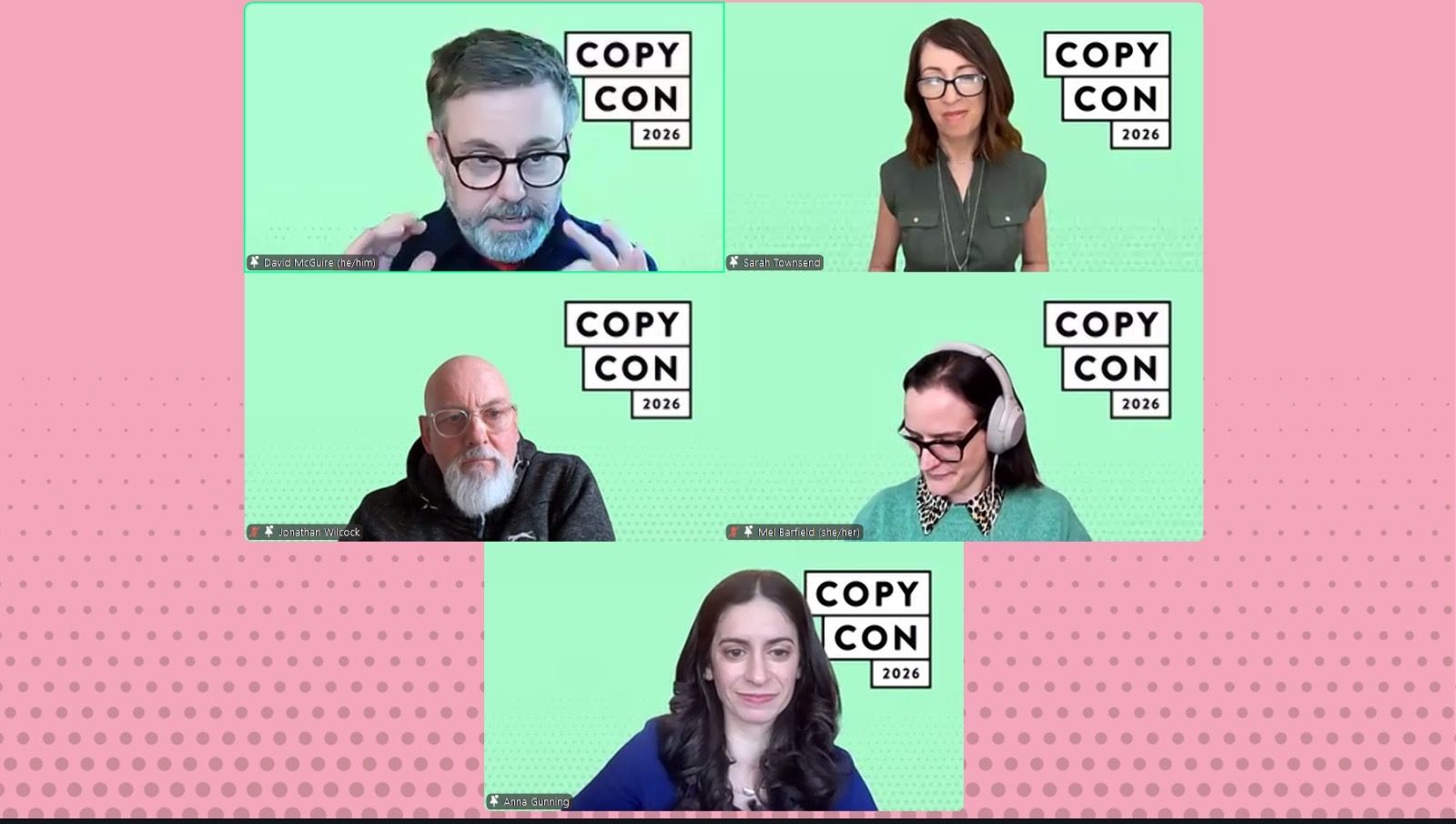
There's no shortage of AI hot takes. What's rarer is a room full of senior copywriters and content strategists working through the nuance together (without an agenda to sell software or to catastrophise).
That's what CopyCon 2026: AI vs Humanity delivered.
Here are the 4 takeaways for marketing leaders trying to make smart decisions about content and AI right now.
There was a great analogy in the opening panel: the shift from longhand to typewriters to word processors each changed how writers work and how the brain processes writing. Each felt seismic at the time, but each development led to a workflow evolution, not an extinction event.
GenAI is the same kind of shift – significant, but not existential. It sits in the toolkit alongside a thesaurus, a research tab and a brief. It’s useful at certain points but it’s not a substitute for judgment.
The risk for marketing teams isn't that AI replaces good copywriters, it's that it makes it easier to produce a high volume of content that looks polished but lacks the strategic thinking that makes it work. After all, in copywriting, the words are the façade – the value comes from the strategic thinking that goes behind the words.
GenAI has wow factor on the superficial layer, but the wrong words don't get you the right result. Knowing which words are right/wrong – and why – requires understanding your audience, your positioning and your competitive context. That’s the strategic foundation you get from expert copywriting, and you don’t get that with AI, just like you don’t get it with an intern.
The AI-generated content conversation reflects a wider translation problem between the virtues of volume and value. In an age of AI slop, campaigns won’t cut through unless they create an emotional connection with the audience.
Therefore, the content marketing machine needs to step back and consider:
For marketing managers fielding questions from directors about ROI, this loop matters. Copy that can't be connected to outcomes – brand awareness, lead generation, sales enablement, thought leadership positioning – is hard to defend. Copy that's been briefed and created with that loop closed is a different conversation entirely.
This is the kind of strategic content thinking that separates a copywriting partner from a word-count supplier.
Generic output, however fluent, can't manufacture that connection with a target audience. GenAI is very good at polish – and that polish can sand away exactly what makes copy persuasive. Like relatability, honesty and the slightly rough edge signal that a real person understands the actual reader/viewer/listener.
For B2B content specifically – where buyers are sceptical, decisions are high-stakes and trust takes time to build – this matters enormously. The content that builds a pipeline isn't the content that sounds most like everyone else.
We were invited to speak on the Business Development panel, and it was clear that our experience isn’t unique – AI is part of the conversation, but it’s not a silver bullet.
The most memorable line of the day was: "The road of indecision is littered with flattened squirrels."
It got a laugh. It also landed as genuine advice – not just for copywriters figuring out their AI approach, but for the marketing teams working with them.
The businesses getting the most from their content right now aren't the ones who've resolved every question about AI, they're the ones who have prioritised strategy and quality, found partners who share that standard, and kept experimenting.
CopyCon 2026 confirmed what we're seeing in our own work: the surface of copywriting is changing faster than the substance. Volume is easier and polish is cheaper, but the strategic thinking, the ability to synthesise insight, the copy that makes a reader stop and actually feel something – that's where the value is, and where it's increasingly concentrated.
If you're a marketing leader trying to work out how to use AI sensibly, how to brief for better content outcomes, or how to make the case internally for investing in quality copy, get in touch.
Anna Gunning is the director of Gunning Marketing, a specialist B2B copywriting and content strategy agency based in Birmingham. She works with scale-up, mid-market, and enterprise businesses across technology, manufacturing, energy, property and construction, finance, and professional services. She has been writing B2B content for more than 20 years.