





Marketing Careers
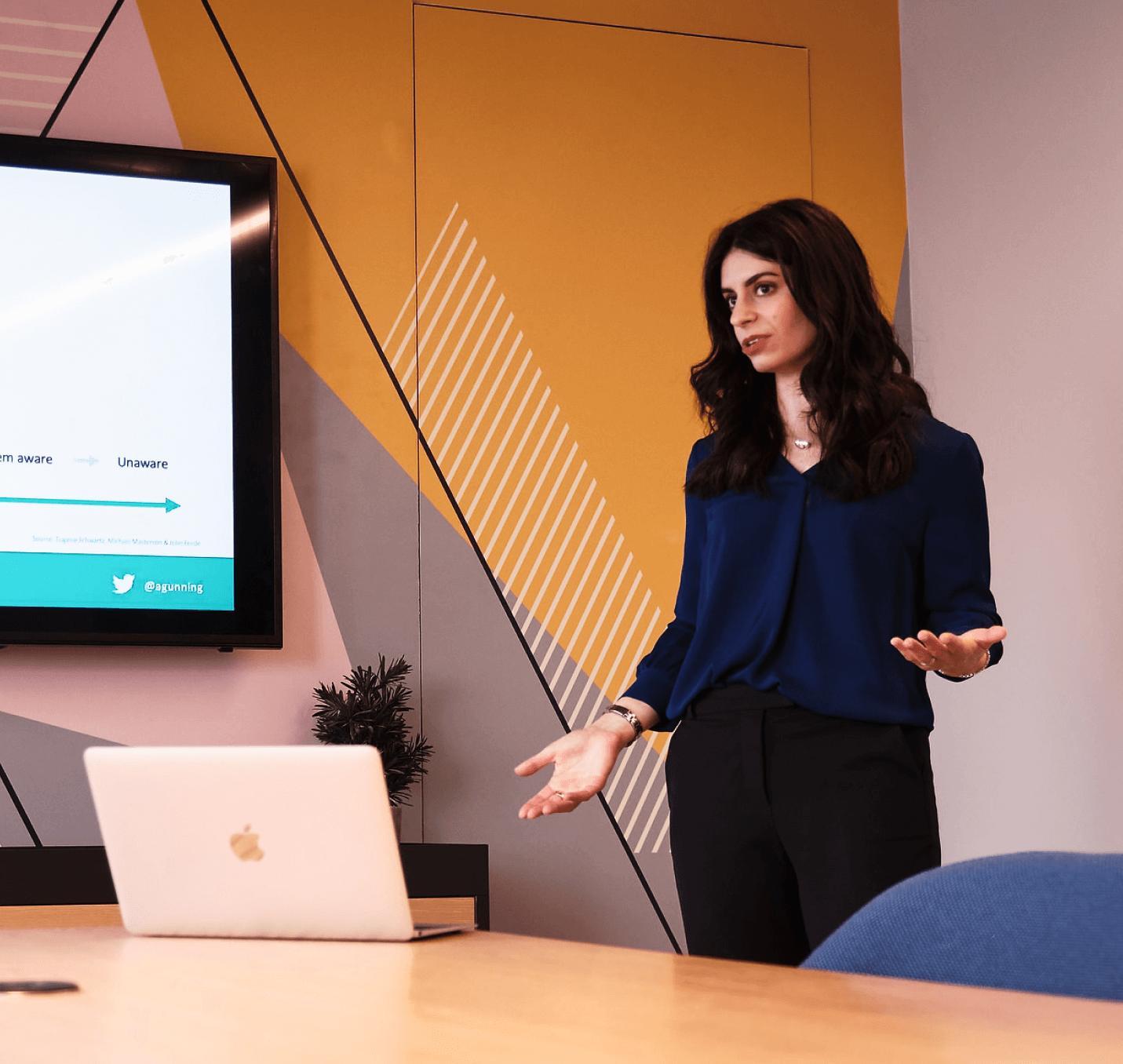
Build and enhance your in-house teams' copywriting, content marketing, and digital marketing skills with interactive, engaging training they can put into practice right away.
Gunning Marketing training covers tailored copywriting, content marketing, and AI content creation for in-house marketing teams. Sessions are interactive and practical, built around a business's own audiences and existing content so participants leave with tools they can apply immediately.
Training sessions suit marketing, communications, PR, and content teams of any experience level, from those new to copywriting to seasoned professionals looking to sharpen specific skills.
Great for beginners and seasoned pros, every one of our training programmes is completely bespoke to your requirements.
Hire us for one-day intensive workshops with a specific focus, or let us help with your marketing team's continuous professional development.

Our goal is to make things easier for you the next time you're faced with a blank screen.
Brush up on tried-and-tested techniques, sharpen old skills, or learn new tricks.
We deliver the kind of training we love attending ourselves: useful, engaging, and fun.
Master the art of writing to sell — from PAS, AIDA, and other core copywriting frameworks to more advanced techniques.





Thank you so much for our copywriting training day yesterday – you did a brilliant job. In fact, several team members have told me it’s the best training they’ve ever had. This is in no small part due to your thorough preparation – using examples of content from our own website and social channels. The pace was perfect, the tools you provided for the team were really practical, and I’m looking forward to seeing some great copy from them in the coming weeks and months.

I picked up lots of new tricks and ways of working that can be translated into business as usual.

I have learned so much from working with Gunning Marketing.


Want training that leaves your in-house teams all fired up and raring to go?
Improving writing quality across a whole team requires more than training individual contributors in isolation. The most durable improvement comes from establishing a shared standard – a clear articulation of what good looks like for the business and its target audiences – and then building the skills and habits to meet that standard consistently. Without the shared standard, individual training improves some contributors but doesn't change the baseline.
The shared standard starts with the briefing process and foundation. Establishing a brief template that requires every piece of content to answer the same foundational questions – who is the reader, what do they need to know or feel differently, what is the single most important point, what proof points are essential – provides strategic focus that improves quality.
A content foundation – with key messages and tone of voice – then provide a baseline to ensure consistent alignment with the strategic direction all content needs to take.
Training that produces lasting improvement is built around the team's own content and audiences. Reviewing real pieces the team has produced, identifying specific patterns that are holding back quality, and practising the rewrite on content that matters to the team creates muscle memory.
This is why Gunning Marketing's approach to copywriting training uses examples from the client's own website and channels. For instance, following a bespoke copywriting workshop we delivered for 30 communications professionals at the Association of Accounting Technicians (AAT), Head of Communications Janice McKee commented: 'Several team members have told me it's the best training they've ever had. The tools you provided were really practical, and I'm looking forward to seeing some great copy from them in the coming weeks and months.' Copywriting training for the West Midlands Combined Authority produced similar feedback: 'I picked up lots of new tricks and ways of working that can be translated into business as usual.'
The most important thing to look for is whether the training provider will build the programme around your team's specific content challenges. Training built around your brand voice, content types, audiences, and your team's specific gaps produces fast improvement. You want attendees to come away with techniques they can apply immediately when they’re next faced with a requirement or blank screen.
Look for a trainer with genuine B2B content experience. B2B content has specific requirements – understanding complex propositions, writing for multiple stakeholders in a buying process, connecting content to commercial outcomes – that generic writing training doesn't address.
Also ask about how the training handles the AI question. In 2026, a copywriting training programme that doesn't address how team members should work alongside AI tools is missing a significant part of the picture. The most effective approach – developing the skills to brief AI tools effectively, to evaluate and edit AI-generated drafts, and to identify where human writing is essential rather than optional – requires the same foundational skills as writing well from scratch. A trainer who understands both copywriting craft and AI's role in content production is considerably more useful than one who addresses either in isolation.
The business case for bespoke in-house copywriting training is strongest when off-the-shelf courses won't address the specific gaps that matter. Generic training improves abstract writing skills that may or may not transfer to what the team actually works on. Training built around your brand voice, content types, audiences, and examples from your own channels produces immediately applicable improvement. The business case is particularly strong when:
Established courses from industry bodies and standalone training companies have real value – they can provide professional accreditation and a broad framework for marketing thinking. What they don't provide is the ability to write compellingly in your brand voice, for your specific audiences, on your specific content types. A copywriting course built around generic examples teaches principles that participants then have to translate back into their real work, a gap that slows down behaviour change and often means the learning doesn't fully transfer.
Bespoke training closes that gap. When the examples used in training are the team's own homepage, case studies, LinkedIn posts, and the like, participants leave with immediately applicable skills rather than principles they need to figure out how to apply.
Training is the right choice when the primary need is building lasting internal capability – specifically when:
External copywriting support is the right choice when:
In practice, the most effective model for many B2B marketing teams combines both. Training builds the internal foundations – the persuasive writing skills, the editorial judgement, the ability to evaluate and edit drafts effectively. External resources handle the content that requires specialist depth or exceptional quality: a whitepaper, a product launch, a flagship thought leadership piece. The internal team and the external partner develop a working relationship where each makes the other more effective.
A further option is the fractional content leadership model – where an external specialist operates as an embedded Head of Content or Content Director, providing strategic direction and quality oversight while building internal capability over time. This gives junior team members the professional development benefits of working alongside a senior practitioner on real projects, rather than applying training in isolation. Gunning Marketing has provided this model for a range of clients, training internal content writers while handling the high-value production and providing the editorial standard against which the team's own work is calibrated.
The decision ultimately comes down to what the business needs to be true in 2 years. If the answer is 'a capable in-house content team,' training is essential. If the answer is 'consistently excellent content regardless of who produces it,' an ongoing external partnership may be more reliable. If the answer is both, the combination model is worth the investment in relationship-building.
Training that changes behaviour rather than just awareness is designed around practice and application, not just information transfer. The content used in training should be relevant to your organisation so team members can clearly see how principles apply in their context. Participants need to leave the training with techniques they can use the next time they have a writing task.
Follow-through after the training matters, too. A practical toolkit – a brief template, a quality checklist – gives participants something to refer back to when they're writing under pressure 3 weeks later. That anchor helps embed the behavioural change.
The most durable results come from training that's reinforced by the working environment. If the team's line manager briefs to the same standard that was taught, if the review process checks against the same criteria, and if the external content partner the team works with models the same approach – the new behaviour becomes the new normal rather than an extra effort. Gunning Marketing designs training with this reinforcement in mind: the tools provided are the same tools used in our live client work, and the standard taught is the standard we apply.