Interviews & Media

In this episode of the Trendy Words podcast, host Andrew Monro spoke with Anna Gunning, Director of Gunning Marketing, to explore why the word ‘passionate’ fails in B2B marketing — and how businesses can move beyond the generic and the buzzwords to differentiate.
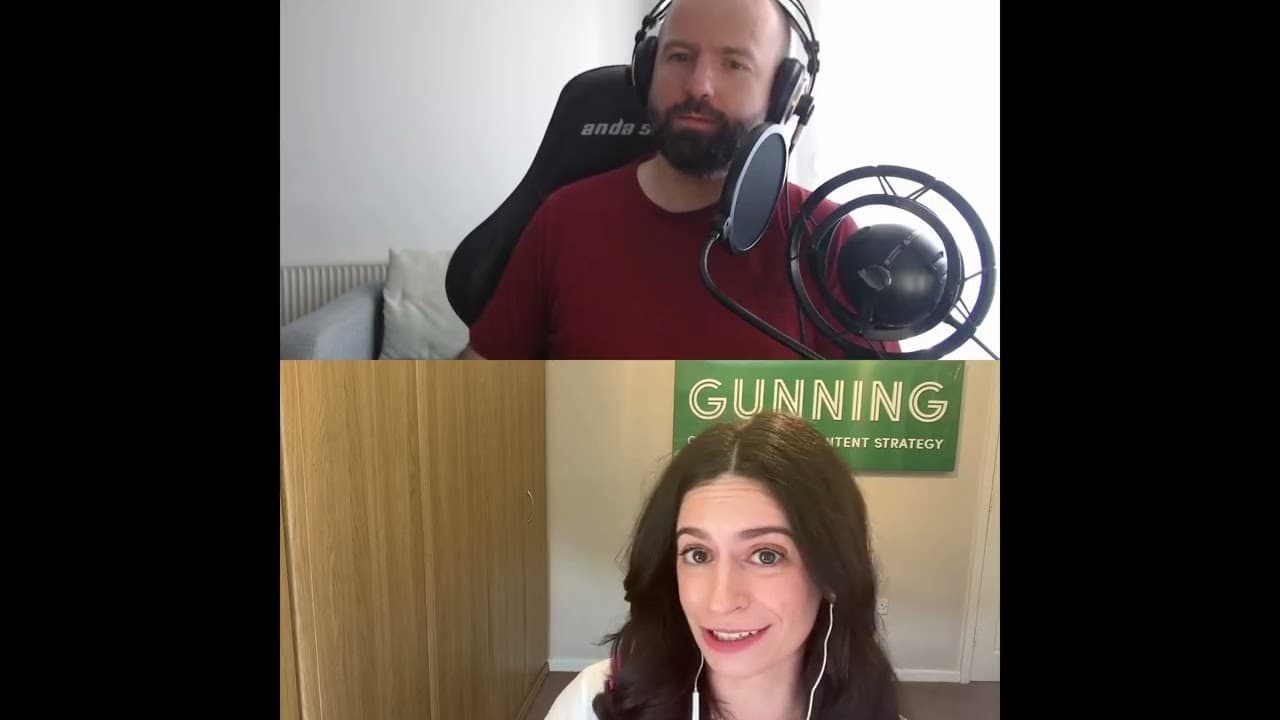
Andrew – Welcome to Trendy Words, the podcast about the meaningless, misleading and nonsense words we use in business marketing, and what we can do about them. My name is Andrew, copywriter and voted Most Likely to Tangent Off Topic during a meeting. Our word for this episode is passionate, and I’m joined today by my guest, Anna Gunning.
Andrew – Hi, Anna.
Anna – Hi, Andrew. How are things?
Andrew – Very well, thank you. I’ve known Anna for about 8 years and she’s one of the reasons why I now live in Birmingham. For those who don’t know you as well, would you share a bit about who you are and what you do?
Anna – Yes. I’m the Director of Gunning Marketing, which is a B2B copywriting and content strategy agency founded 10 years ago. I work with scale-up, mid and enterprise-level businesses that need authoritative and technically capable writers to deliver clear content.
Our specialist domains are technology, industry, energy, property and construction supply chain, manufacturing, finance and professional services. The content that I do is around value propositions and tone of voice, content strategies, web copy, thought leadership copy, all sorts of marketing collateral, and then also annual and ESG reports.
Andrew – You’ve pretty much done just about everything there is to do in the world of B2B copywriting. And you’ve been doing it for, I think, probably about twice as long as the rest of us.
Anna – And so it’s probably about 20 years in total in B2B copywriting. And I’d say I’m very passionate about B2B copywriting 😉. And that takes us into the discussion about why I don’t like the word passionate.
Andrew – So why is passionate a weak word to use in marketing?
Anna – Passion isn’t bad. And I don’t want this to come off as a polemic against passion, because people are genuinely passionate about what they do. Like I’m passionate about B2B copywriting.
And passion is important! I like working with happy, enthusiastic people who are motivated to do great things in whatever their domain is. The reason why I don’t like it in marketing is because people will often use it as a default USP or differentiator.
Being passionate about what you do doesn’t make you stand out from competitors in any way – because they’re presumably passionate as well. So having passion doesn’t necessarily make you a better partner within whatever B2B supply chain you’re part of. And that’s why I push back when I ask clients why prospective customers should choose them, and they say, ‘We’re really passionate.’
That’s not quite enough to go on when you’re trying to craft compelling marketing messaging that’s going to resonate with the people that you’re speaking to.
Andrew – It’s one of those words where, when you stop to think about what the opposite would be, it seems silly. No business is going to say: ‘We’re an incredibly poorly motivated and lazy company.’
So that’s not a differentiator. So when the opposite is not in any way meaningful, saying things like passionate doesn’t actually mean anything.
Anna – It’s the way that you’d think about any other marketing message you’re putting out there. It doesn’t pass the ‘So what?’ test in terms of why people should care about it. Why should your audience care that you’re passionate about what you do?
That’s the ‘So what?’ thing I often go through, and I know lots of other copywriters often go through it too when they’re working with clients. The client will say something, and you’ll say, ‘So what?’ in order to get behind what the meaning and the value of that statement is. So, when somebody says, ‘We’re really passionate and that’s really core to why people should choose us’, it doesn’t pass the ‘So what?’ test.
What do we go into?
Does being passionate mean you’re making something that’s higher quality because you care about it more? Then we can dig into where that higher quality might be coming from. Does it mean you offer a really great service because you’re really passionate? Okay. Let’s dig into some of the specifics around that.
It can be a jumping off point for finding out what the ‘so what’ is and why the audience should care. But on the surface, there isn’t any reason why the audience should care that you’re passionate.
It’s the same way as often find in press releases, where people will say: ‘We are delighted to announce….’
And you think: ‘Congratulations. I’m glad you’re delighted.’ Will other people be delighted that somebody else has been announced as the new Chief Marketing Officer? Other than the Chief Marketing Officer, I’m not sure.
Andrew – Yeah. Your friends and family and your closest associates who are invested in your internal position care, but the rest of us – and more importantly, your customer – what do they get out of knowing you’re passionate? What does it matter to me if someone has been appointed to a new position? Does that mean I’m going to get better customer service?
Anna – Yes, exactly. So, it’s digging into what the benefit to the target audience is. This isn’t to denigrate the value of the labour illusion bias and input bias. Those are behavioural biases that do exist and can be leveraged in marketing. That’s the idea that when you put blood, sweat and tears or effort into something, there’s more value to you as a result. For example, people feel more positively towards flat-pack furniture because they put the effort into building it than they do towards something of comparable quality they’re buying pre-built already. Youu place higher value on something the more input that goes into this. Studies back this up. For example, in marketing messages, saying ‘It took us 840 hours to design this product’ means people associate more value with it because the inputs are perceived to be valuable.
Passion does feed into inputs but it isn’t the only input. And that’s where the ‘So what?’ test keeps coming in. The input of passion is important, but what does that translate into? How many hours spent refining a design or the type of technology that you’ve invested in? Or training and processes to give great customer service leading to high first-call resolution?
It’s a balance, because, as I said, I love working with passionate people, and everybody should be passionate about what they’re doing and what they’re marketing. It’s just about thinking about the right way to frame that.
And incidentally, if you’re interested in labour illusion bias or input bias, Phill Agnew has a really good episode of it on his Nudge podcast. He summarises different studies, which is fascinating to listen to.
Andrew – That’s what my next question was, because I don’t think I’ve ever heard the phrase labour illusion bias before. So you feel more committed to something because you’ve already put, time, effort, blood, sweat and tears into what you’ve done.
Anna – That’s a more negatively framed way of putting it. The way that it’s used successfully in marketing is to show the value that goes into the creation of something. Like, ‘I put 800 hours into designing this’ or ‘We’ve machined 100s of components to perfection to make this widget’ – because it goes to perception of quality. If you spent so much time and effort on something, then the assumption is that it’s higher quality.
Andrew – Right. Is there a downside to using passionate in that way? Like, has it ever set expectations that can be let down, say if it doesn’t line up with the actual customer experience?
Anna – I haven’t seen blowback like that. I suppose it would be the same as anything else you put forward in your marketing.
So speed: If you say ‘We have a 24-hour lead time on producing our widgets because you have a just-in-time supply chain’ – and you don’t deliver within the 24 hours – you’re not delivering the experience to back up the marketing.
Passion would be the same, if customers are interacting with people who don’t seem like they want to be there. That’s problematic and could affect retention and your ability to get onward business from word of mouth and recommendations.
But I don’t think that it’s more likely to cause blowback than other differentiators or marketing messages.
Andrew – Ultimately, It just doesn’t mean anything. Would you go back to a customer later and say, ‘Did you find the experience terribly passionate?’
Anna – And when you phrase it like that, it doesn’t come off quite so well!
Andrew – Yeah, clients would probably think you were crazy!
Anna – I probably wouldn’t have that in the NPS follow-up survey as a metric 🙂Again, it goes to the ‘So what?’ test.
What is the thing that demonstrates that passion has come through in the customer experience? Is it something like first-call resolution? Is it hitting that 24-hour lead time? If you’re in software development, is there something around the DORA metrics? Does it come through in your Net Promoter score (NPS) in terms of people being recommending you?
Those are all ways that your passion can manifest itself in the customer experience – or in the product or service you offer – that can be reflective of what’s behind the passion.
Andrew – How would you go about bringing up the ‘So what?’ test in a corporate meeting? I imagine it doesn’t work well when you have to talk to a group of people and say, ‘Why should I care?’ That comes off a bit harsh.
Anna – We’re professional and supportive. The job obviously isn’t to denigrate clients in any way. It’s part of our job as copywriters to ask the right questions and to frame the conversation so we get the inputs we need. I would say it’s framing it around showing rather than telling.
Saying we’re passionate – that’s the telling. How can we show it?
It’s like anything else when you rely on telling rather than showing – you get generic positioning and generic messaging.
So rather than saying you’re passionate, how can we show it? For example, could we do videos of solution architects talking about migrating monolithic applications to cloud? Or plant managers talking about how using sensors and IoT and simulation modelling is helping optimise throughput? It’s showing passion through people talking enthusiastically and authoritatively about a subject that’s of value to your target audience. Because then you’re getting into the specifics that show the passion – showing the expertise in a way that adds value to the customer’s purchasing process.
You could also show passion with social proof – case studies and testimonials. If passion is the input, like we were talking about before, what statistics realistically reflect the output? Is it that first-call resolution, the time to market being speeded up, the reliability, the staff retention, the repeat orders?
How can we break it down to show how that passion is meaningful and of value to customers?
Andrew – For the longest time, Octopus Energy talked about their passion in terms of how they often went above and beyond in customer service. And they have the awards and customer service feedback to back that up. That would be a good example everyone would be familiar with.
Anna – Octopus also ran adverts with recordings from customer service calls, with clips of the actual customer saying, ‘Wow, I’ve never talked to an energy company that resolved something so easily’. And ‘Thank you so much! You were so very helpful.’
That’s going even further, putting the voice of the customer front and centre in an audio format that shows passion in action.
Andrew – It follows on that point of showing what being passionate really means.
Anna – Yes. I often say that you often get value from working with a copywriter or other types of branding or marketing consultants because, as a company, it’s hard to read the label from inside the bottle. You feel the passion and it’s important to you. And that’s wonderful, because passionate stakeholders are much more likely to engage with the marketing strategy development process and have interesting inputs. But saying you’re passionate is reading from inside the bottle – and we need to get them to have that external view.
And that’s what they’re paying us and using our expertise to do.
Our job as copywriters and content strategists and marketing consultants is to ask the right questions and bring our expertise on how to shape the stories and messaging in a way that will resonate with the target audience.
Here are some hypothetical yet concrete examples. If I ask a client what differentiates Acme Limited from its competitors and they say, ‘We’re really passionate’, I’ll dig into that. There are lots of ways to steer them and get them to think in the way I need them to – so I get to the nuggets we need to make the marketing fly.
These are all different angles to dig into where the source of that passion is. So you can get to the output and what’s really going to speak the customer’s language or align with their challenges, pain points and goals – as opposed to the passion, which is reading it from inside the bottle.
Andrew – That’s good advice for any business leader who isn’t sure how to talk about their passion: start with talking to your customers. Ask them where they find positive, uplifting and outstanding moments in their experiences working with you.
Anna – Frontline sales and customer service people will also have really good insight into the language customers use, the questions customers ask when they get in touch and at different points of the decision-making process, what they say when they have an issue and when the issue is resolved. Or even your social media people doing social media listening and have their finger on the pulse of what’s online. There are ways to get insight without going directly to customers because there’s a lot of insight within the organisation among people who have direct customer contact.
Andrew – That also makes the whole process more authoritative. You’re not just passionate because you say so. It’s much more powerful if you can get the customer to say you’re passionate.
Anna – 100%. If someone describes you as passionate in a testimonial, there’s no problem with that – it’s a wonderful thing for someone to say. I push back against the word with clients because it’s not something to say about yourself – you’ll be more effective from a marketing perspective if you don’t let yourself rely on passion.
Andrew – It’s similar to using the word ‘trust’ in marketing – saying ‘We are trusted’, or ‘We are trustworthy’. It’s only meaningful if somebody says that about you.
Anna – Yes. It’s very easy for ChatGPT to write a whole paragraph for you about how passionate you are. But does it actually help with your sales and marketing?
For instance, a lot of clients I work with are in competitive markets and don’t necessarily have anything proprietary in technology or approach that’s hugely differentiating. Going beyond the generic and really digging into how passion manifests helps them be more specific in their marketing – and therefore helps them stand out more effectively against competitors saying similar things at a top level.
Andrew – Often, businesses think they know where they’re excelling, but when you talk to customers, they value different things. Many times with IT clients, the speed of the help desk is a chronically overlooked and under-loved aspect from an internal perspective, but it makes or breaks the experience for the customer.
Anna – It depends on the project. Some copywriting projects don’t necessarily need a full-scale analysis with lots of customer interviews or a full review of the customer journey and the customer experience. Others do. So it’s about identifying, based on the project goals what depth of research you need.
Also, the most relevant way to frame the passion goes back to Marketing 101:
When you have all of those basic copywriting brief elements set out, you then have a framework for directing the specificity so it best contributes to the campaign goals.
Andrew – Yes, and it generally makes it so much easier starting from that point. I think with the ‘inside the bottle’ situation you described, so much is similar across companies. So, it’s very normal to come up with the same kinds of ideas because it often feels like a similar experience.
Anna – But that’s also where copywriters can have fun. Even if there’s not much difference in approach – like you don’t have a proprietary technology or process to work with – you can put a stake in the ground that’s different from the competition. So your differentiator isn’t just that you have great people doing great things.
The way that you say it is where the copywriter comes in. The tone of voice, the framing, the headline message you use – they can be differentiating. That all influences the campaign and helps the client stand out to their customers.
So there are lots of tools in our copywriter arsenal we can use. So your client isn’t just ‘enabling digital transformation’ or whatever, like everyone else. Yes you are, but show don’t tell
Andrew – Yes, it’s the literal thing you’re doing, but it’s not in any way describing the experience you deliver – and it doesn’t touch on why someone would want to work with you over a competitor
Anna – Which goes back to what you were talking about earlier, in terms of framing it in a different way. How can you show rather than tell the passion? Is it through videos where your human side comes out and your people show their authority, expertise and passion? Is it through case studies, testimonials, statistics and other proof points? Those are techniques you can use to stand out in a situation when everybody’s passionate, everybody’s enabling digital transformation, everybody has fast turnaround times.
Andrew – If somebody wanted to get to know you more or to reach you, how would they find you?
Anna – I am on LinkedIn (@annagunning), gunningmarketing.co.uk and anna@gunningmarketing.co.uk
Andrew – Cool thanks very much, Anna.
Anna – Thanks, Andrew.